
I applaud the effort on Edwards' part but feel his message will create little change. If Edwards is any kind of indicator where Evangelicals want to go then they have a long road to travel with regards to many issues. Politics being one. Edwards equates politics with social action. I don’t understand how pushing for moral legislation will create legitimate change and transformation within society. It’s one thing to restrict someone from crossing a line. It’s an entirely different thing to transform a person so that the line is never even considered as something to be crossed.
Also, I disagree with Evangelicals approaches to anything anti-Christian. They (or at least Edwards) see things like secularization and extreme Islam as issues to be fiercely attacked. It’s important to have answers for our faith and to be able to defend it, but Evangelicals have a defensive nature in general, leftover from reactions to the Enlightenment and the rise of Evolution, and they declare a holy war against issues instead of being so engaged in the work of Christ that their actions and their love speak for themselves.
Also, Edwards, admitting that Evangelicals fell behind in social work through most of the 20th century—stresses the work done since 1970 and even in the 18th and 19th centuries—doesn’t seem to relate a holistic approach to missional work. Personal salvation is their starting point, it’s the main focus, at the expense of clean drinking water, or medication for those dying of AIDS, or protections for the oppressed. Not that Evangelicals don’t offer those things. But it’s as if Evangelicals want to save people just because Jesus commanded them to, not because they genuinely love them. Because we’re also called to love them, and in loving them, we missionally not only provide Christ, but also provide a blanket, or a glass of water, or a soccer ball.
An Agenda For Change helped me see where much of my frustration towards Evangelicals is coming from. At times I agreed with Edwards’ points wholeheartedly, at others I was cringing and frustrated. It’s a needed agenda for evangelicals, I just wish it embraced more change.
Dr. Wesley Paddock (I don't know if that's his real name) offers a more in-depth book review (here).
Sabbath ceasing [means] to cease not only from work itself, but also from the need to accomplish and be productive, from the worry and tension that accompany our modern criterion of efficiency, from our efforts to be in control of our lives as if we were God, from our possessiveness and our enculturation, and finally, from the humdrum and meaninglessness that result when life is pursued without the Lord at the center of it all.
Keeping the Sabbath Wholly
Saw this quote from Marva Dawn and wanted to share it. I believe she lives in Vancouver. She's an amazing thinker, writer, theologian, and speaker. Her book Reaching Out Without Dumbing Down: A Theology of Worship for This Urgent Time is a must read for worship ministries.
I also shared this quote because I'm hoping to read and review Abraham Joshua Heschel's book The Sabbath. I think a lot of us forget the importance of taking a Sabbath, especially those in ministry. So it should be a fun look into what Sabbath means.

Matt Rogers was working as a pastor April 16th, 2007, when 32 students were killed at Virginia Tech University, in one of the worst mass killings in modern American history. Rogers works through the grief and pain of the event that reminds him of our morality and forces the question, Why?
Rogers interviews one student who witnessed the shootings and miraculously survived. The student accounts the experience in horrifying detail. Rogers also interviews two parents who lost six of their nine children in an accidental explosion. Rogers asks difficult questions, faces the ugly truth, opens his own hurting wounds, and finds that God is good.
He searches for God’s presence in the beautiful South Carolina woods, along the Atlantic Ocean, and walking among the Colorado Rockies (which provide some of his best written scenes). He looks for God’s goodness standing beside gravesites, among the poor and needy, and in the church community. He works through the process of grief and calls us to imagine what the world will be in the future. Continually reminding us of Christ’s long-awaited renewal of the world.
Written in a meditative style that echoes Philip Yancey, Brennan Manning, and Henri Nouwen, Rogers is a voice that will offer comfort and hope. When Answers Aren’t Enough is available today (April 1st) (here with a sample chapter) and his second book Losing God: Clinging to Faith Through Doubt and Depression (Intervarsity Press) is due out in November (found here).
1. Bioethical violations such as birth control
2. Morally dubious experiments such as stem cell research
3. Drug abuse
4. Polluting the environment
5. Contributing to widening divide between rich and poor
6. Excessive wealth
7. Creating poverty
Here's an idea. Maybe the Vatican should worry about displaying and sharing Christ's love, to the extreme that people begin to fall in love with and follow this Jesus Christ, and, naturally, out of their love and discipline for him, won't want to sin. Then the Vatican won't have to worry about making sure people throw away their trash in the park. Just a thought.
Great story of a guy who gets mugged, last month, by a teenager in the Bronx, and ends up treating the kid to dinner. [Read here]

We kept circling the city. No one slept. Our captain chimed in periodically to reassure us. But the know-it-all had predicted we’d be out of fuel in forty-five minutes. That was nearly an hour ago. Conversations dried up, except for an occasional nervous whisper. I closed my eyes and tried to remember how to pray.
But my thoughts drifted. It dawned on me that since Katie’s funeral, my whole life had been just like this, a holding pattern. I’d spent the last decade and a half going in circles, hovering, marking time, waiting for tragedy to strike. All the while, life happened on the other side of the clouds. I jolted awake when the plane’s tires thumped onto the tarmac. Somehow I’d managed to stave off my date with destiny by nodding off.


Jonathan Raymond's Half-Life weaves together two stories of friendship and loss. Raymond's details of the Pacific Northwest wilderness are lush and evocative. His pictures of relationships are adept and endearing. Find the book here.
 Philip Roth's Exit Ghost is the latest (and possibly last) of his Nathan Zuckerman novels. Roth enthusiasts love to find the similarities between the fictional Zuckerman and real Roth and Roth appears to advocate that looking to close makes it so, "the essence of the artifact is lost."
Nathan Zuckerman returns to New York city after living in the Massachusetts hills as a recluse for the past eleven years. His literary fame, early in his writing career, began with death threats in the form of post cards and forced his isolation. But a new procedure to improve his incontinence returns him to Manhattan where he rashly decides to swap his Berkshire cabin for a city apartment with a literary couple. Zuckerman becomes enraptured by the young woman, Jamie, besides the fact that he's impotent due to prostate surgery.
I find Roth brilliant, but I won't gush. It's a great read. As are all of his novels. OK, I'll stop now. But really you should read it.
These are some example of how I stay secure in a dangerous city.
The University of Portland baseball team beat 8th ranked University of Michigan 4-3 in 10 innings on Friday. Earlier in the week the Michigan Wolverines tied the New York Mets in an exhibition game. Also, earlier in the week, University of Portland lost to Division III George Fox.
The moral of the story:
George Fox should be a National League contender.
Or,
Baseball is a strange, yet beautiful, game.
On Monday afternoon, towards the end of Art History 206, a security officer opened the door to the small auditorium classroom and announced that there was a bomb threat in Neuberger Hall and the building was being evacuated. We all left immediately. Some moving faster towards the exit than usual.
According to the Portland State University student newspaper, The Vangaurd, "A professor found the threat, a note in the men's bathroom that read, 'There will be a detonation in Neuberger Hall at 4:30 p.m.'"
The building didn't explode.
The next day my friend Dan, who served a year in Iraq, told me about his friend, a member of the Israeli Defense Force, who was walking out of the building with an Arabic friend as it was being evacuated. Once outside the Arab saw a group of his Arab friends standing around. He started laughing and telling them, "You better get out of here. You all might get arrested."
Dan thought it was cool that an Israeli and Arab were friends.

One of my favorite authors is an Israeli writer Amos Oz. His novel Fima is about a middle-aged divorced man named Fima, who works as a secretary at a gynecology clinic. He's a brilliant man, but as all his friends say he's unmotivated, a kind of an oaf. He continuously tells himself that he's going to get his act together, going to get that Ph.D., or run for office, or write another article. He loves his ex-wife's ten year old son, and his ex-wife, and he sleeps with his best friend's wives.
Oz has a patented pattern to his stories. It's an undisturbed rhythm. Methodical but precise. The most powerful scene is when Fima visits his ex-wife Yael, attempts to get her to run away with him, but she's upset, exhausted, and recalls a time when they were married and she went to the abortion clinic:
"It was also in the winter. It was February then too. Two days after my birthday. In 1963. When you and Uri were completely absorbed in the Lavon affair. The almond tree behind our kitchen in Kiryat Yovel had started to flower. And the sky was just like today, perfectly clear and blue. That morning there was a program of Shoshana Damari songs on the radio. And I went in a rattling old taxi to that Russian gynecologist in the Street of the Prophets, who said I reminded him of Guiletta Masina. Two and a half hours later I went him, as fate would have it in the same taxi with the little photograph of Princess Grace of Monaco over the driver's head, and that was that. I remember I closed the shutters and drew the curtains and lay down in bed listneing to a Schubert impromptu on the radio, followed by a lecture about Tibet and the Dalai Lama, and I didn't get up till eveing, and by then it had started raining again. You had gone off early in the morning with Tvsi to a one-day history conference at Tel Avic University. it's true you offered to skit it and come with me. And it's true I said, For Heaven's sake, it's not worse than having a wisdom tooth out. And in the evening you came home all glowing with excitement, because you had managed to catch Professor Talmon out in some minor contradiction. We murdered it, and we said nothing. To this day I don't want to know what they do with them. Smaller than a day-old chick. Do they flush them down the toilet? We both murdered it. Only you didn't want to hear when or where or how. All you wanted to head from me was that it was all over and don with. But what you really wanted to tell me was about how you'd made the great Talmon stand there on the dais in confusion like a first-year student flunking an oral. And that same evening you rushed on to Tsvika's, because the two of you hadn't had time on the bus back to Jerusalem to finish your argument about the implications of the Lavon affair. he could have been a boy of twenty-six by now. he could have been a father himself, with a child or two of his own. The eldest about Dimi's age. And you and I would go into town to buy an aquarium and some tropical fish for the grandchildren. Where do you think the drains of Jerusalem empty out? Into the Mediterranean, via Nahal Shorek? And the sea reaches Greece. and there the king of Ithaca's daughter might have picked him out of the waves. Now he's a curly-haired youth sitting and playing the lyre in the moonlight on the water's edge in Ithaca. I believe Talmon died a few years ago. Or was that Prawer? And didn't Giulietta Masina also die? I'll make some more coffee. I've missed the hairdresser now. It wouldn't do you any harm to have a haircut. not that it would do you much good either. Do you still remember Shoshana Damri at least? A star shine in the sky,/ And in the wadi jacks cry? She's completely forgotten now, too."
All of the Oz novels I've read are set in Israel during the 1980-90s. Issues of war and love are common themes. Also, the broken middle aged man as the main character. His most recent novel was just released in Israel, so I'm hoping there will be a translation soon.
Another Israeli writer, Ron Leshem, was nominated for an oscar with the adaptation to his novel Beaufort. It's the story of Israeli soldiers during the first Lebanon War. You can read the first chapter here. It reminded me of O'Brien's The Things They Carried with his use of repetition. It's a moving opening to the book. Watch the movie trailer here.
Driving down backed-up Lancaster Dr. today, we made our way to Borders so I could buy some Chekov and Beckett short stories, and then to JOE's (when did they take off the G.I.?) to return a Portland State shirt my mother didn't know I already owned. I bought a black Nike t-shirt that says, "The Play Maker," which I feel is fitting since I lead my team in assists.
Later in the evening I had a disappointing phan thai at some hole in the wall on forlorn downtown Liberty street. Building after building was up for sale or lease and even though the mall was bustling, even Gov Cup when I walked by, there wasn't much to get excited about. No loud drunks in the street, no police lights flashing, no long lines into clubs.
Salem is a spread out city with a small-town mentality. Not that I mean to pick on Salem, I just think that it has so much promise and then fails to deliver. For example, Salem only has one bridge across the Willamette River which makes commuting for West Salemites difficult and is just plain stupid that there isn't at least two bridges. And, much of the riverside property is unused and rundown property, which is ironic compared to Portland, where even a view of a glimpse of a tree that's within 200 yards of the Willamette goes for a couple million.
Karin Holton's rebuttal to the oft repeated "There's nothing to do in Salem," believes there's plenty to do in Salem. Unfortunately I read the article to late and missed the auditions for the upcoming "Sunshine Boys" .
If I did make it to the audition, I would have worn these Robert Wayne shoes.
Now I'm going to switch to a completely different topic.
I want you to think of the most embarrassing thing you've ever done alone. So embarrassing that if someone had seen you it would be the most embarrassing thing you've ever done.
Here is mine:
My parents bought a video camera one day on a whim. We were at the Clackamas mall and my brother and I had a hockey game (which was in the mall) later that day. My mom taped all our hockey games that year, like the one in the Eugene tournament with 8 seconds left when I skated the puck into the slot, was tripped, and while falling down, scored the game tying goal to put us into the championship game. She would tape Christmas and Easter and birthdays and family reunions and parties.
This Christmas we pulled out all of those tapes from the closet and started watching them, laughing at the good old days. As a creative child I often used the camera to make movies. Godzilla was my best film. A stuffed Barney played the T-rex that kills everyone but my sister.
Also included in my film credits was a beer commercial, a few ESPN commercials, an unfinished gangster film, and...the most embarrassing of all: a music video. I was 14 when I filmed it in my garage wearing a tank top, beanie, and headphones. Most of the time I was singing along with the music in the background (Switchfoot "I Dare You To Breathe"). For some reason I thought I had destroyed the tape. Like in "The Ring" this tape is indestructible and came back to haunt me. My family was laughing so hard they were rolling on the floor crying and all went to bed that night with horrible headaches because of it.
Whatever you do when you're alone, just be thankful you haven't made a video of it.
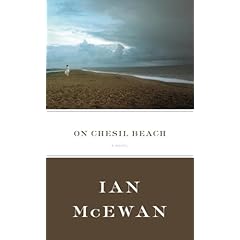
When a newly married couple attempts to consummate their marriage in early 1960's England at Chesil Beach, the unsaid is said along its shores and Florence leaves her eight hour old husband, Edward. Ian McEwan's short novel Chesil Beach delineates the pre-counter-culture movement between the young couple and their indelible past.
McEwan is a master craftsman switching voices between the couple, drawing on Florence's musical skill, her husband's promise to sit in seat 9 row C at her debut concert; upon Edward's fascination with history, the ever-present apocalypse, and the emptiness he creates when that seat is empty.
Chesil Beach shares themes with his Booker award winning novel Atonement--which is also a movie showing in the States in limited theaters (starring Keira Knightley) and earning 7 golden Globe nominations--of what cannot be undone, the story that can't be re-written.
Here is my favorite scene from Atonement which is now my all-time favorite movie:
I went looking for an award winning book of Christian fiction and found Charles Martin's When Crickets Cry. I couldn't believe I'd never heard of him before. I even went to Powell's and didn't find his books in the shelves. I found a voice I didn't know I was looking for. Poetic, lyrical, funny, honest, and gripping. I've only read two out of his five novels, but he is an author you can't pass up.
It's an injustice to Martin's work to call it Christian fiction. It's literary as well as Christian—one novel is described as suspense, others are described as Southern Lit.—but there's also romance, and there are elements of Man Lit. (if such a thing existed). It's a lot of things and the beauty of his novels is that you finish them changed, moved, uplifted. That's a precious thing.
His novels explore losing loved ones, dealing with the tragic past, looking for hope in the world's mess. His voice is genuine, vulnerable, sentimental, and Christ centered.
I'll save any summaries because you can find all that plus the first chapter of his books on his website, so if you do get a chance to read something of his let me know what you think.
Other reviews:
• Then We Came to the End by Joshua Ferris
• Fieldwork by Mischa Berlinski
• In the Country of Men by Hisham Mitar
• The Echo Maker by Richard Powers
If God is real, the trees seem to proclaim it louder.
Oregon's liberal stance is no mystery to the rest of the union. But so often religion is inferred as politics in the mass' mind and progressive activists are considered godless heathens, at the least, and "republican" becomes a derogatory term.
Politics and religiosity become infused into an awkward battle where strategy and funds and signatures and governors and hippies and God and gay and trees and apocalypse are lumped into the same paragraph as well as the same breath.
I do not doubt the day when two men or two women exchange rings freely will come. Maybe not this year or this decade, but it will happen. And many will label this the downward fall of America, the soon to be Sodom of our time. But rest assured there will be a worse day to come. One that will cause people of this world to cry out because of their own hatred, to weep for their malicious words and acts of evil against the lost of this world. It is heart breaking what the withholding of love has done. For those who refuse to show mercy and grace will have mercy and grace withheld from them (James 2:13).
Philip Yancey's The Jesus I Never Knew describes consequences of not showing love or showering grace,
"A prostitute came to me in wretched straits, homeless, sick, unable to buy food for her two-year-old daughter. Through sobs and tears, she told me she had been renting out her daughter -- two years old! -- to men interested in kinky sex. She made more renting out to her daughter for an hour than she could earn on her own in a night. She had to do it, she said, to support her own drug habit. I could hardly bear hearing her sordid story. For one thing, it made me legally liable -- I'm required to report cases of child abuse. I had no idea what to say to this woman.
“At last I asked her if she had ever thought of going to a church for help. I will never forget the look of pure, naive shock that crossed her face. "Church!" she cried. "Why would I ever go there? I was already feeling terrible about myself. They'd just make me feel worse."
The story of the Bible isn't one of condemnation, it is one of seeking, God seeking and longing to be with his people. And the story climaxes with Jesus dying on the cross, but it doesn't end there, for the resolution is being played out now, with you and me and the church.
Open arms will direct the lost to Him, but pointing fingers and closed arms will only push them away. And God is seeking the lost, the hurt, the confused, the you's and me's and them's and these, and he will not stop looking as he did not stop himself from dying.
The past two consecutive nights I've awoken to couples fighting outside my apartment window. Their screams and shouts echoed back and fourth off the brick. One girl I thought was laughing, was in fact crying hysterically for her boyfriend to come back, come back here dammit! I don't know if he came back. And I wondered if she was left there alone in her tears, empty handed chasing after what she wanted. And it reminded me of all the things I chase after that leave me crying and alone.
Even when we don't deserve it, even when we run in the opposite direction, Jesus comes chasing after us. This example is displayed so beautifully in the book of Hosea.
Hosea was asked by God to go and find a wife and he told him beforehand that she would be unfaithful. So Hosea did as the Lord said and he married a woman named Gomer. And together they had three children, 2 boys and one girl.
God was using the symbolism of Hosea and Gomer's marriage to represent God and his relationship with his people the Israelites. And as God said beforehand, Gomer left one night and did not return.
I can imagine Hosea waking up to find the other side of the bed cold and empty. He rises and checks on the children, kissing them on the cheek and pulling the blankets around them tighter. And I can see Hosea stepping quietly outside and looking into the distance. I see tears streaming down his face as he waits in silence.
Morning awakes and he does not see her in the horizon and soon the mid-day's heat is bearing down on the back of his neck, but his eyes do not waver as his heart continues hoping. And finally God says to go and find her, for she is with another man. And I can imagine Hosea running as fast as he can, a pillow of dust rising behind his path, his sandals falling off his feet as he continues on barefoot, frantic to find his love.
He bursts into a stranger’s home and slams down enough money to buy her back for she has become another man's slave. And he throws his arms around her and he cannot stop kissing her as the tears roll down his face.
What is that feeling? As we toil and labor in our house of slavery, in our hopeless lives of sin. But what is that sound? Footsteps? A madman screaming? The door explodes and there he stands, his scarred hands stretched out to you, his teary eyes starring into yours. He embraces you, and holds you, and cannot stop kissing you.
And here, God, the beautiful poet, whispers his loving words in your ear,
"Arise, my love, my beautiful one, and come with me. See! The winter is past; the rains are over and gone. Flowers appear on the earth; the season of singing has come, the cooing of doves is heard in our land. The fig tree forms its early fruit; the blossoming vines spread their fragrance. Arise, my love; my beautiful one, come with me." (Song of Solomon 2:10-13)
